

Tidbits related to food, cooking, nutrition + medicinal applications
Lightly dampen a paper towel, or two, then place it beneath the board. This will prevent your cutting board from sliding around on the counter.
Be careful to not get the paper towel/s too wet, otherwise they’ll tear.
Lightly spray the torn piece of plastic wrap with non-stick spray, then cover the food. This will protect the food without pulling any of it off with the plastic wrap.
When measuring out ingredients like peanut butter, honey, molasses, syrup, or similar foods, pull out that non-stick spray again and lightly spray the measuring cup or spoons first.
The measured ingredients will slide right off, keeping your measurements accurate.
Tired of straining to get the lid or cap off that bottle of corn syrup, honey, vanilla bean paste? Me too. So I dampen a paper towel with a bit of grapeseed oil and wipe the threads of the bottle with a good coating.
So next time I use that ingredient, I’m not arm-wrestling the cap or lid to get it open.
It’s true, we usually only need a teaspoon or tablespoon of such ingredients, then the tubes end up sitting in the refrigerator until they’ve gone bad or past their expiration date.
Instead, squeeze what’s remaining in the tube into a small plastic bag, make sure it’s well sealed, then use a black marker to write what it is and the date.
Tired of your flour, cornstarch, or other similar ingredients flying all over the counter when running your upright stand mixer?
Tear off a good piece of parchment or even waxed paper, set it flat on the counter, then pour the measured amount needed onto the paper.
Pick up the paper and fold it slightly, just enough so it works as a kind of funnel, as you pour it into the running mixer. No mess!
If you’re like most people you likely don’t have more than one loaf pan in your kitchen, but you learned and practiced all that bread baking during COVID, so what do you do?
Place the single loaf pan in the center of a 9 x 13-inch casserole dish that has been well-greased and prepared according to your bread recipe.
When it’s time to add the dough, divide it into three portions, then position one section in the loaf pan and the other two on either side of the loaf pan.
If you’re not familiar with “tomato concasse,” the French method used to peel and remove seeds from a fresh tomato, and you’re not concerned with the skin, just the seeds, simply cut the tomato in half and use a grapefruit spoon to remove seeds from each quadrant of both halves. Easy sneezy.
When I need to clean lettuce greens and I don’t feel like searching, then cleaning my salad spinner, I simply spread the rinsed and separated lettuce leaves, flat onto a clean kitchen towel, roll it up like a burrito, and allow the towel to absorb the excess water.
For those of us who did not jump on the sourdough train during Covid and still struggle with consistently pulling beautiful loaves or boules from the oven, we need all the help we can get! Here are some ideas for creating steam in your oven to get that initial rise and create a crispy, shiny crust!
*Place a large cast iron skillet in the oven when turning on to preheat. When it’s time to set your bread dough inside, first pour some boiling water or even ice cubes into the cast iron skillet, creating that first burst of steam.
*Using a water-only spray bottle, spray the sides of your oven and lightly mist the bread dough when initially putting it inside the oven. Repeat this a couple more times during the first 10 – 15 minutes of baking.
*Soak 2 or 3 kitchen towels with water, place them in a pan or skillet in the oven while preheating. This creates a nice steam bath, prepping the oven before you put the bread in. Be sure to remove the towels when the bread goes in!
Note: steam is needed in the first 15-20 minutes of bread baking for maximum spring to your bread. If you cook with a gas oven, know they self-vent. This makes it more challenging to retain steam. I suggest baking your bread as a boule, in a Dutch oven with a lid. I lightly mist my dough, once it’s in the pot, then covering it for the first 15-20 minutes to create that steam.
Chef’s know the chocolate they use makes a difference in the final outcome of whatever dish they’re preparing.
With dark chocolate, if you’re looking for sweetness, good choices include: Callebaut dark bittersweet, Baker’s bittersweet baking and good ole, Hershey’s special dark mildly sweet.
For a more distinct character to your dish, consider, one of these two chef’s favorites, Valrhona Guanaja 70% bittersweet or Scharffen Berger bittersweet pure dark 70% chocolate.
Now that we have easy access to pasteurized milk, we’re no longer forced to scald our milk before cooking or baking with it to avoid illness. So why do some chefs still use this method?
Frankly, many don’t anymore. There’s no benefit to scalding milk when preparing sauces, such as béchamel. Same thing with regard to preparing pastry cream – not necessary.
However, for bakers, scalding the milk when preparing bread dough does make a difference. Scalding yields better rise and lighter crumb.
Some Italian recipes instruct you to fry up some capers, those delightful, pickled Mediterranean buds. But if you’ve ever done so, you probably experienced some popping and spitting in the pan that resulted in some bites and stings on your hands.
To avoid this, pour the measured amount of capers required, capers only, no liquid, into a couple of paper towels that have been folded over a few times. Press the capers between the layers of paper towel to remove as much moisture as possible.
Then start the frying of the capers in cold oil, over low heat. While the capers will still open, far fewer will pop and sting.
and to make things more interesting, most chefs will purchase unique or hard-to-find ingredients whenever possible.
One such item is the red banana. Instead of using a standard yellow banana, if you notice some short, red bananas at your local farmer’s market don’t hesitate.
Use these when making your morning smoothie for a beautiful pink beverage. Or in place of plantains, when preparing platanos, try red bananas instead.
These can also be eaten raw, like your standard yellow banana.
Though oregano is commonly used in Mexican, Greek and Italian cooking, there is a slight difference.
While Italian and Greek are quite similar in that both are a bit milder than Mexican oregano, peppery yet sweet, Mexican oregano tends to be more floral and pungent with an undercurrent of citrus.
You may already be familiar with tapioca, the pearls we use when making tapioca pudding. Meanwhile, tapioca starch and flour are indeed the same thing and can be used interchangeably.
Both terms refer to partially cooking, but they do differ.
Blanching includes plunging the food item/s into a bowl of ice-cold water immediately after removal from the pot of boiling water to stop the cooking process.
Parboiling refers to an extended time in boiling or simmering water and may or may not include plunging the food into ice-cold water, depending upon the recipe.
Using a recipe that requires creaming together the butter and sugar, along with a significant amount of baking powder will yield cake-like brownies.
Recipes instructing you to use an increased amount of chocolate and no baking powder will give you very fudgy brownies.
A recipe with a balance between chocolate and baking powder would make little red riding hood quite happy, as they’ll be just right.
Actually, all butters are sweet cream, as this simply means the butter was made with regular cream instead of sour cream.
Labeling their products as “sweet cream” is more of a marketing ploy.
In this case, “everything old is new again.” You may have seen one of these wooden tools that look like an odd, two-prong fork with a carved-out section near the top in your aunt’s or grandmother’s kitchen.
Well, they’re making a reappearance!
This simple tool is technically called a rack adjuster. It’s used for pushing in or pulling out the racks in your oven.
Instead of risking a burn on the top of your hand as you pull out the bottom rack—or when pulling or pushing both the top and bottom racks—you can keep using oven mitts for grabbing hot dishes, but using a rack adjuster will make sliding the racks in and out much safer and help prevent burned knuckles.
THE BENCH SCRAPER – I’ve many people in my classes, over the years, who own this tool and refer to it as a “scraping thingy.” Well, that’s what it does, but the proper term is “bench scraper.” Originally designed for Bread Bakers and Pastry Chefs, this tool was designed to make cleaning off their work surface or “bench, easier and more efficient.
You bread bakers out there know how challenging it can be to get that wet or dried dough off the counter. Your fingernail just doesn’t cut it. For bakers and pastry folks, it’s the same thing with icing and fondant, after it has had time to dry out on the counter. Hence the need for an actual tool does the scraping for you.
The bench scraper is also an excellent way to gather then transfer chopped, diced or otherwise cut foods from the counter to your pot or skillet. Instead of piling the food onto the edge of your chef’s knife then making two, three or four trips from cutting board to stove, use a bench scraper to gather and transfer the food. You’ll make only one or two trips. And no bits of food on the floor!
Easy to find in most any kitchen supply shop and one of the least expensive, regularly used kitchen tools, ever! They come in a variety of styles, some with measurements on them, some made of silicone, others with handles.
This site is about everything food, including books about food. And I’m not talking just cookbooks.
While many are already familiar with Ruth Reichl’s list of fine food writing, for those of you who are into good mysteries, here’s one piece of food fiction you’re sure to like:
The Coincidence of Coconut Cake, by Amy E. Reichert.
An easy and enjoyable read, with her recipe for coconut cake at the end!
Alone In The Kitchen With An Eggplant
Confessions of Cooking for One and Dining Alone
Edited by Jenni Ferrari-Adler
I love this book! It’s a compilation of short stories written by famous authors such as Ann Patchet, Amanda Hesser, Laurie Colwin and Ben Karlin, to name a few. Each author has written a story, tied to food and eating, of course. They then either include personal recipes within each story or at the end. Stories range from humorous to touching and thought-provoking, but each one revolves around cooking and eating for one.
When preparing a small batch of sauce, a dip or pesto. I love pesto, but I don’t always need 2 cups of it!
Black & Decker makes a great mini one as does Cuisinart. Even Hamilton Beach offers this handy gadget. These babies run from about $30.00 to $70.00 and hold 24 ounces.
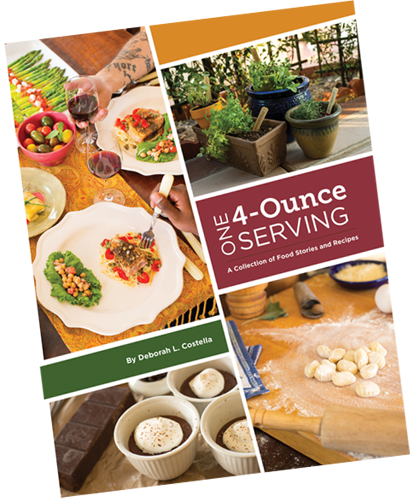
get the book!
For those who, like author Chef Deborah, read cookbooks as if they are the best fiction ever written, this book is for you!
Sign up for class here: https://events.humanitix.com/spring-has-sprung-pasta-and-other-delights